The war in Ukraine expanded this week with the sinking of a Russian warship at a naval base in Benghazi, Libya, as the United States and Europe disagreed over how to advance negotiations to end the war. German media also reported that Russia may be preparing to place a nuclear weapon in space. In the Gulf, President Trump raised the prospect of renewed strikes on Iran after the start of the new year, Tehran announced tighter shipping restrictions in the Strait of Hormuz, and the Houthis attacked the area around Saudi Arabia’s largest oil refinery. Oil prices rose again. On the economic front, Washington proposed new tariffs on 14 economies, Congo announced a halt to cobalt exports, and Nvidia reinstated its CEO after White House intervention.
This week on the map
Drag to rotate the globe
The interactive map is available online.
Item in this issue
Places covered in this issue. Select a number to jump to the item.
Earth imagery: NASA Blue Marble · Borders: Natural Earth (public domain)
US envoy Jared Kushner wrote that security guarantees for Ukraine—including a commitment to help it in the event of another attack, modeled on NATO’s Article 5—cannot be finalized separately from future security arrangements between Russia, NATO and European countries. The European Commission and German Chancellor Friedrich Merz responded that a ceasefire must come first, followed by a peace agreement, and only then a discussion of Europe’s security architecture. President Volodymyr Zelensky expressed readiness for a meeting involving Ukraine, Europe, the United States and Russia. President Vladimir Putin invited European representatives to Moscow before agreeing to expand the format of the talks.
In 1954, Soviet Foreign Minister Vyacheslav Molotov proposed a pan-European security treaty in which the United States would participate only as an observer. Nearly two decades passed before the negotiations culminated in the Helsinki Accords, which also included commitments on human rights, cooperation and military transparency. Today, the order in which issues are negotiated is itself a source of political leverage. This time, however, the call to discuss European security arrangements in parallel is coming from Washington rather than Moscow.
Trump said he was inclined to resume strikes on Iran after the start of the new year if no agreement was reached, and threatened to sink ships attempting to break the US blockade. The following day, Iranian army commander Hatami ordered tighter shipping restrictions in the Strait of Hormuz until Tehran’s seven conditions were met, including the lifting of the blockade and sanctions. The Islamic Revolutionary Guard Corps reports almost daily that tankers have struck mines, but the Joint Maritime Information Center (JMIC) has not confirmed the reports. Qatar’s prime minister met Marco Rubio and JD Vance in Washington in an effort to restart talks. Trump has previously threatened to resume strikes without carrying out those threats, and his latest statement leaves several more weeks for mediation.
After the Iraqi government threatened to take Jurf al-Sakhar—a major stronghold of pro-Iranian militias south of Baghdad—by force, a compromise was reached: Kataib Hezbollah is to withdraw within about a month, while Iraqi security forces, which have already begun entering the area, will assume responsibility for its security, including the oil pipelines that cross it. The move followed suspicions that the militia had smuggled hundreds of millions of dollars’ worth of oil. Esmail Qaani, commander of Iran’s Quds Force, traveled to Baghdad to mediate. The agreement is a gain for Prime Minister al-Zaidi’s efforts to extend state control, but the transfer of territorial control is not the same as disarming the militia.
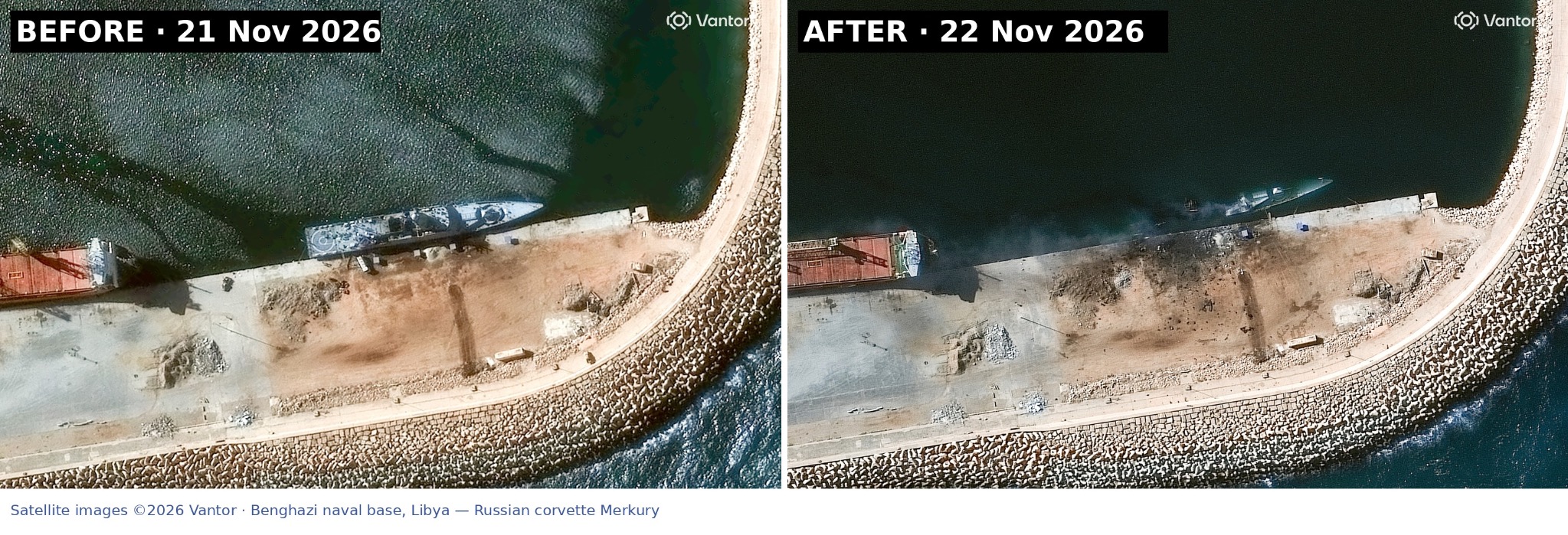
Ukrainian uncrewed vessels sank the Russian warship Merkury, one of the Russian navy’s newer corvettes, at the naval base in Benghazi. According to Zelensky, a Russian cargo ship carrying weapons was also hit. A day earlier, the cargo vessel Sparta II was struck in the Gulf of Finland while sailing to Kaliningrad; Finland said Ukraine was likely responsible. Two officers serving forces under Khalifa Haftar’s control in eastern Libya were killed, and Haftar threatened retaliation. Both of Libya’s rival governments condemned the attack. Ukraine had previously targeted Russia-linked ships in the Mediterranean in December 2025, but this time a Russian warship was sunk at a naval base in a third country. The attack illustrates the Russian navy’s vulnerability far from the Black Sea and adds another international dimension to Libya’s conflict.
The Houthis continue to advance toward Aden, and government forces have established a defensive line around the city. The Houthis said they attacked the refinery at Ras Tanura—Saudi Arabia’s largest, located near a major oil export terminal—as well as Riyadh’s financial district. The Saudi-led coalition confirmed that drones were intercepted in the area, and satellite images showed thick smoke above the refinery. The extent of the damage and its effect on oil supplies remain unclear, but Brent rose by about 3.5% after the attack. The expansion of Houthi operations against Saudi energy infrastructure makes the war in Yemen a more direct threat to the global oil market.
According to German media, Western intelligence services assess that Russia could launch Sputnik-S, a satellite carrying a nuclear warhead intended to disrupt or destroy other satellites, as early as December. German Chancellor Merz called the reports “shocking”; NATO Secretary General Mark Rutte pledged that the alliance would protect its members in space as well; and the Kremlin denied the reports. Placing a nuclear weapon in orbit would violate the 1967 Outer Space Treaty.
The Soviet Union deployed a fractional orbital bombardment system (FOBS) in the 1960s that circumvented the treaty’s restrictions and was dismantled by 1983. What has changed since then is the extent to which the global economy and security systems depend on satellites. A threat of this kind could therefore serve as strategic leverage even if it is never carried out.
The US Trade Representative proposed new tariffs on 14 economies under Section 301 of the Trade Act, which allows tariffs in response to trade practices deemed unfair and harmful to US commerce. The administration argues that production exceeding demand is damaging American industry. The maximum proposed rates are 20% for China, 35% for Vietnam, 25% for India and 15% for the European Union, Japan, South Korea, Taiwan and Switzerland. The additional rates in practice will depend on existing tariffs and the exemptions ultimately established. The proposals have not yet been approved, and hearings are expected in January. After the Supreme Court struck down the “Liberation Day” tariffs, the administration has continued to pursue its tariff policy through alternative legal tools, including after its midterm election defeat.
Brent crude rose to $94.61 a barrel following the attack in the Ras Tanura area and continued strikes on ships in the Strait of Hormuz. At the same time, Gulf oil exports have increased in recent months, while Dubai oil prices signal a short-term supply surplus. OPEC+ ministers are due to discuss 2027 production quotas on November 29, with the United Arab Emirates no longer bound by the group’s policy. Despite expectations of a surplus, low oil inventories make the market more sensitive to further damage to Gulf energy infrastructure.
Nvidia’s board reinstated Jensen Huang as CEO less than a week after saying it would not bring him back. According to the Associated Press and Reuters, the reversal followed pressure from Trump, and the company said senior US officials assessed that his return posed no national security risk. The investigation into suspected foreign intelligence activity will continue, and several members of Congress opposed the decision. The administration’s involvement illustrates Nvidia’s status as a strategic US asset and the close link between technological competition with China and national security policy.
Venezuela’s government published an economic framework putting the combined debt of the state and national oil company PDVSA at $237.5 billion, including $110 billion in bonds and $67 billion in oil-company liabilities. The government described the debt as unsustainable and pledged to develop a comprehensive agreement with creditors, but the size of any write-down has not yet been determined. The announcement is a first step toward a return to international financial markets following Maduro’s removal. An agreement with creditors, including American, Chinese and Russian parties, will also affect how future revenues from Venezuela’s oil industry are distributed.
The Democratic Republic of Congo, which produces roughly three-quarters of the world’s cobalt, announced that it would suspend exports of the metal from November 30 until further notice because of oversupply and falling prices. Cobalt is an important raw material for electric-vehicle batteries and heat-resistant alloys used in aerospace and defense. This is the second suspension since 2025; after the announcement, cobalt futures prices in China reached a more than three-month high. The move demonstrates how countries that control critical mineral supplies can influence global production chains, including China’s cobalt-refining industry.
The ousted prime minister, who has lived in exile in India since 2024, announced plans to return to Dhaka on December 16, Bangladesh’s Victory Day. The government said Hasina, who was sentenced to death in absentia, could return through an extradition process and accused her and India of fueling unrest. It remains uncertain whether she will return, but her announcement has heightened political tensions in Bangladesh and complicated efforts to rebuild relations between Dhaka and New Delhi.
The UN climate conference, COP31, ended in Antalya without an overarching final agreement. The European Union, the United Kingdom and several countries particularly exposed to the effects of climate change rejected the final draft because it did not mention reducing fossil-fuel use, while oil-producing countries opposed such a commitment. Alongside agreements on technical issues, the central dispute remained unresolved. Three years after the Dubai conference commitment to move away from fossil fuels, the international community is struggling to agree on how to implement it.
By the numbers
114
Vessel transits through the Strait of Hormuz facilitated by the United States over three days, according to the Joint Maritime Information Center (JMIC).